
Personal reflections · Failure, learning and service
Shunya
The Courage to Unlearn
To remain an observer. To remain a student.
To keep asking: how can I serve?
Published by GeNext MedEd Foundation
In this essay
What experience asks of me
When I speak of real experience, I do not mean a list of successes. I mean the experience of failing—and discovering how much I still have to unlearn.
It is possible to collect achievements without examining oneself. Failure makes that examination harder to avoid. Something we believed would work does not. A judgement we trusted proves incomplete. The person we imagined ourselves to be meets a reality that does not accommodate that image.
Even then, learning is not assured. We can spend years explaining a failure without allowing it to change us. We can become skilled at defending our intention while remaining unwilling to examine our part in what happened.
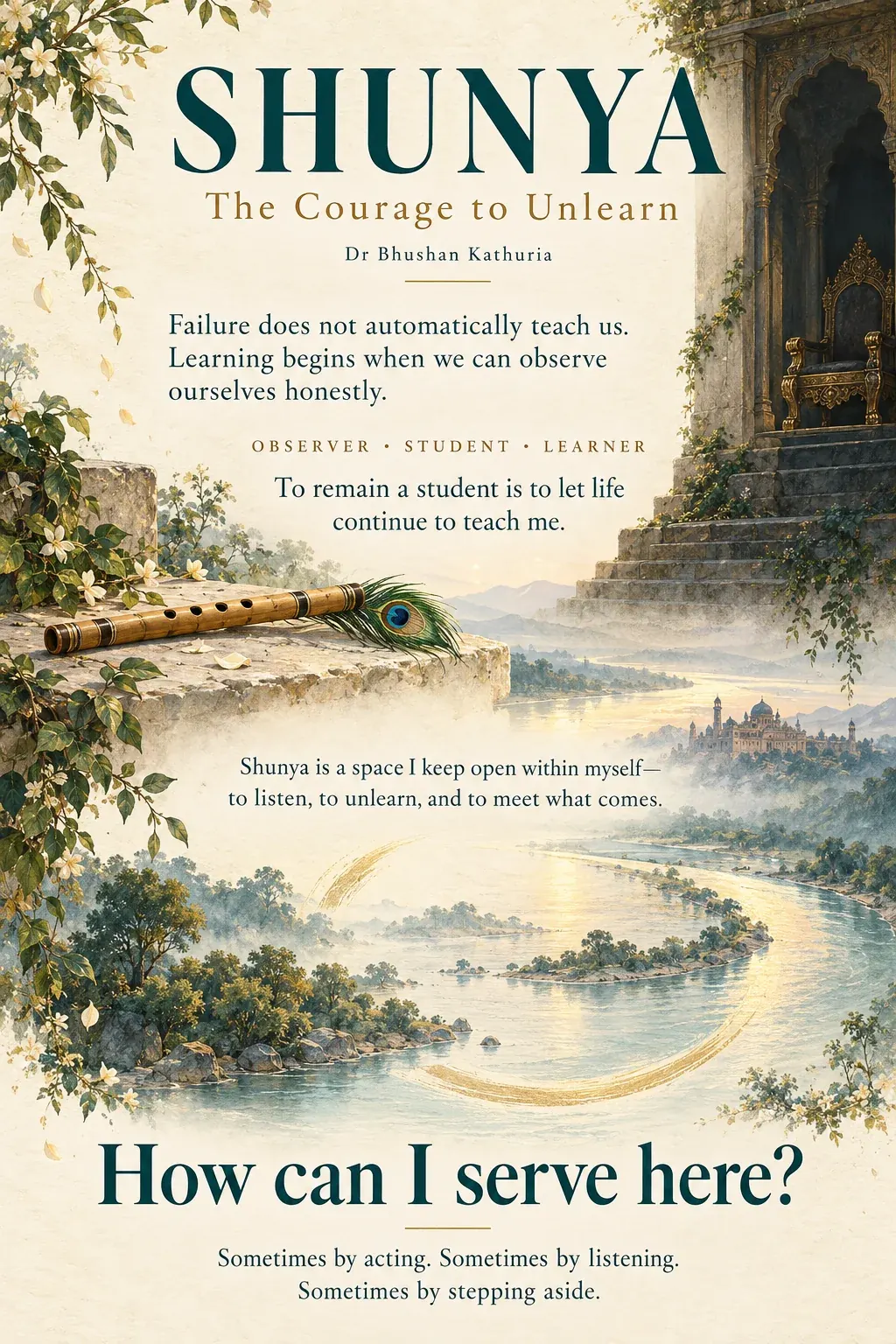
Failure does not automatically teach us. Learning begins when we can observe ourselves honestly.
The flute and the throne
I find myself drawn to a contrast in the way I imagine Krishna.
Krishna playing the flute offers an image of beauty, music and affection. Dwarkadheesh brings another image to my mind: the throne, responsibility, competing loyalties and decisions that cannot please everyone.
I use this as a personal metaphor, rather than an account of scripture. The flute can be admired from a distance. The throne asks what it means to remain responsible when admiration is absent.
In that image, there is room for disappointment, hurt and the feeling of betrayal. Yet hurt can also narrow how we see. Feeling wronged does not make every judgement of ours correct. Having suffered does not remove the need to examine our own part.
That may be the most difficult unlearning: to look inward even when we have reasons to look elsewhere.
The courage to risk failure again
The courage to fail again asks more of me than persistence. It asks me to recognise what happened, accept consequences, change what needs changing and remain willing to act. Where other people bear the consequences, that courage must include restraint.
There is no wisdom in making failure an achievement of its own. Repeating a mistake without examining it does not become learning simply because it is painful. Sometimes the next honest step is to stop, ask for help or let go of a plan.
Before learning something new, I may need to loosen my grip on something old: the need to be right, the need to appear capable, or the belief that my intention should determine how others experience my actions.
Observer, student, learner
To remain a student is to let life continue to teach me. A person, a disagreement, an ordinary day—each may reveal something I have not yet understood.
Observation must also turn inward. Can I watch my own reaction? Can I notice the moment I become defensive, the moment I seek recognition, the moment I stop listening because I believe I already know?
I am part of what I need to understand.
To observe myself is not to stand outside responsibility. It is to become more attentive to how I participate: what I assume, what I avoid and what I bring into the room before another person has spoken.
To remain a student is to let life continue to teach me.
Returning to shunya
This is where I place shunya.
For me, shunya is a return to zero—a place where a title, an achievement or a grievance cannot answer on my behalf. Experience remains, but it must be examined. I can say, “I do not know,” without immediately covering the silence.
I think of it as a state of truth: a willingness to meet what is there before deciding what it must mean. I do not mean that I have reached a final understanding. The openness has to be renewed whenever certainty closes it.
Failure alone does not bring me to shunya. Neither does success take me away from it. What matters is whether I remain available to learn, without forcing every experience to justify my past or serve an imagined future.
There will be practical goals, decisions and responsibilities. Yet I do not want my life to become only a pursuit of targets. I want to meet what comes with attention—to learn from the flow of life without needing every moment to become an achievement.
How can I serve here?
In this sense, shunya is a space I keep open within myself. A space where I can listen before claiming to understand, and respond before asking what the response will bring me.
A purpose remains: to serve.
Service begins with a question whose answer I cannot assume: How can I serve here?
Sometimes by acting. Sometimes by teaching. Sometimes by learning from the person I thought I had come to help. Sometimes by listening long enough to discover that what is needed differs from what I wanted to offer.
I may need to step forward. I may need to step aside.
To remain an observer, a student and a learner is to keep that question alive. Shunya becomes a way of returning to it—with less certainty about myself, and more attention to the life before me.
How can I serve here?
Publication notes
A personal reflection by Dr Bhushan Kathuria, developed from his own words on failure, unlearning, observation and service. The Krishna–Dwarkadheesh contrast and the understanding of shunya are personal interpretations, not claims of scriptural authority. No individual patient or identifiable private incident is described.
Published by GeNext MedEd Foundation on 26 October 2026. Version 1.0. Editorial preparation and the accompanying artwork were assisted by AI. This is a reflective essay, not a peer-reviewed research article.
Cite this essay
Kathuria B. Shunya: the courage to unlearn. GeNext MedEd Foundation; 2026. https://www.genextmed.org/perspectives/shunya-the-courage-to-unlearn
© 2026 Dr Bhushan Kathuria · No DOI has been assigned.
For corrections and permissions: manager@genextmed.org